Integrating packaging machinery into an existing production line can improve output without demanding a complete factory rebuild. It can also expose weaknesses that were previously hidden. Old conveyors may vibrate. Sensors may report inconsistent signals. Operators may rely on manual adjustments during every changeover.
The practical question is not simply “Which machine should we buy?” It is “how to integrate packaging machinery into existing production lines” without disrupting safety, quality, or production flow. A successful plan examines product dimensions, line speed, available floor space, electrical capacity, controls architecture, and maintenance access. It also maps the handoff between each machine, from filling and sealing to labeling, inspection, and case packing.
As Jorge Izquierdo, PMMI’s vice president of market development, explains, “Integration is not just about connecting machines; it is about making the entire system work together.” This principle matters on the factory floor. A new wrapper may run at 120 packs per minute, but the upstream feeder may support only 90. The advertised speed becomes irrelevant.
Experienced integrators therefore begin with site surveys, production data, and operator feedback. They test communication protocols, confirm guarding requirements, and plan realistic shutdown windows. Small details matter. A poorly placed control panel can slow a shift. An inaccessible sensor can extend maintenance time.
There is no perfect integration project. Unexpected constraints will appear. Careful documentation, staged commissioning, and honest performance testing reduce the risk. The goal is not merely a faster machine. It is a stable, serviceable, and measurable production line.
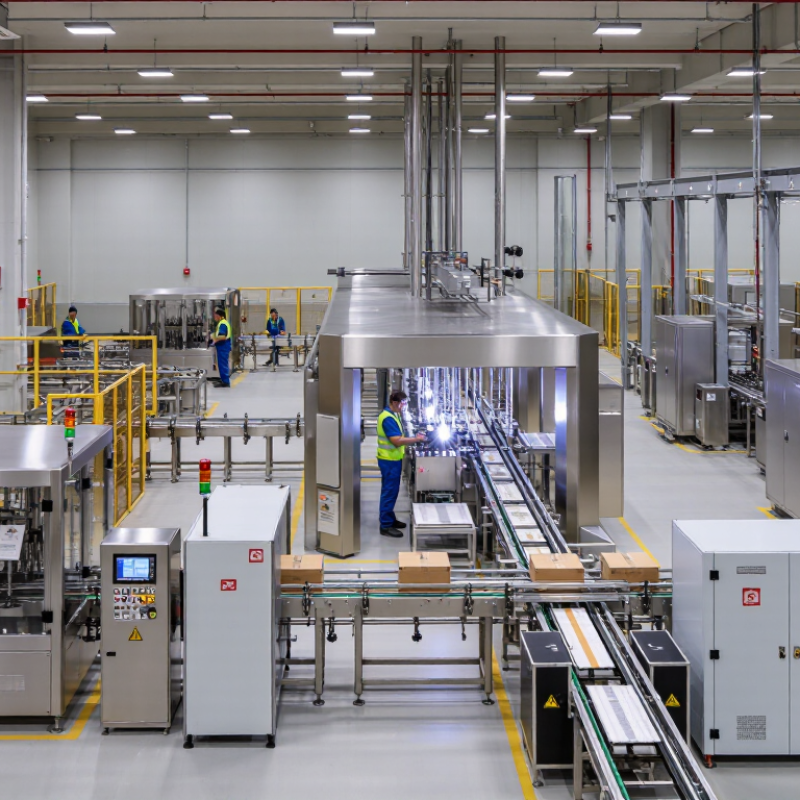
Define Integration Goals Using the 85% World-Class OEE Benchmark
Integrating packaging machinery into an existing line should begin with a measurable production question: what prevents stable output? The 85% world-class OEE benchmark offers a practical reference, not a guaranteed result. OEE combines availability, performance, and quality. If a filler waits six minutes for cartons, availability falls. If a wrapper runs below rated speed, performance suffers. Rejected packs reduce the quality score.
Before choosing equipment, record at least two weeks of real production data. Include changeovers, micro-stops, jams, cleaning, and material shortages. A clipboard check can reveal losses that a dashboard misses. Our first integration estimate was wrong because we counted scheduled hours as productive time. That mistake changed the project scope. Honest baseline data matters more than an attractive target.
Set goals around the whole line, not one machine. An integrated case packer should match upstream speed, downstream accumulation, safety controls, and operator access. Aim for staged improvement, such as moving from 72% to 78%, before pursuing 85%. Test recipes, alarms, and recovery steps during normal shifts. Leave room for learning. Even a short handoff delay can become a daily loss when repeated hundreds of times.
Map Product, Data, and Utility Interfaces Under ISA-95 Standards
Why Integrate Packaging Machinery Into Existing Lines?
Integrating packaging machinery is not only a mechanical task. It is an interface design problem. ISA-95 Part 1 separates enterprise activities from manufacturing operations, creating a useful structure for integration. Product interfaces define materials, recipes, batches, and packaging formats. Data interfaces define schedules, quality results, alarms, and production counts. Utility interfaces cover compressed air, electricity, cooling water, and network access.
A case packer may need a product code before receiving a production order. Its vision system may return inspection results after every carton. The line also needs stable air pressure, often near 6 bar, during repeated pneumatic movements. These details should enter the equipment model before installation. The 2023 State of Smart Manufacturing report surveyed 1,353 manufacturers and found that 97% were investing in smart manufacturing. That investment can disappoint when data fields remain inconsistent.
ISA-95 helps teams map Level 3 manufacturing activities with Level 4 business planning. However, the standard does not remove every practical problem. Different machines may describe rejects, downtime, or units differently. A spreadsheet may hide those gaps until commissioning. That is an avoidable weakness. Engineers should test product, data, and utility contracts with real signals, sample recipes, and worst-case production speeds. The mapping must be reviewed by operators, controls engineers, maintenance teams, and cybersecurity specialists. Some assumptions will still fail. That is why interface records need version control, traceable changes, and live validation during factory acceptance testing.
Select Modular Equipment to Reduce Changeover Time by 30–50%
Integrating packaging machinery into an existing line can improve capacity without rebuilding the entire plant. The strongest gains often come from modular equipment and faster changeovers. A practical target is a 30–50% reduction in setup time, especially when operators use tool-free guides, recipe controls, and quick-release product-contact parts. This is not automatic. Poor sequencing can erase the benefit.
The Lean Enterprise Institute’s SMED methodology separates internal tasks from external tasks. That distinction helps teams prepare formats while the machine is still running. OEE Foundation guidance commonly uses 85% OEE as a world-class benchmark, although many facilities remain near 60%. Shorter changeovers can raise availability, but only when cleaning, inspection, and first-off approval remain controlled. Speed alone is not performance.
Modular design also supports future product variation. PMMI industry reports consistently identify labor availability and flexible production as major packaging concerns. A standardized frame can accept different fillers, labelers, or conveyors without forcing a complete line replacement. Operators need clear settings, visible reference marks, and repeatable validation steps. Keep it simple.
A 30–50% improvement should be measured, not advertised. Record the last good pack, first good pack, labor minutes, and scrap during each trial. Review the result after several shifts. One successful changeover proves little. The uncomfortable finding may be that the machine is not the main delay; material staging or approval often is.
Why Integrate Packaging Machinery Into Existing Lines?
Select modular equipment to reduce changeover time by 30–50%
Illustrative packaging-line benchmark: modular integration reduces average format changeover time from 120 minutes to 72–84 minutes, equivalent to a 30–40% reduction. Shorter changeovers can improve line availability and support more frequent product runs.
Validate Line Performance Through FAT, SAT, and OEE Measurement
Why Integrate Packaging Machinery Into Existing Lines?
The real question is not whether new packaging equipment can run alone. It is whether the complete line can perform reliably together. Factory Acceptance Testing, or FAT, provides an early technical checkpoint. Engineers test machine functions, communication signals, changeover steps, and safety responses before shipment. We record cycle times, reject rates, and recovery behavior under controlled conditions. However, factory conditions are usually cleaner than production reality.
Site Acceptance Testing, or SAT, checks the equipment after installation. Technicians verify conveyor handoffs, product spacing, utilities, guarding, and operator access. A carton may pass FAT perfectly but stall at a transfer point onsite. Small timing errors can create repeated jams. SAT should include extended runs with normal materials and trained operators. Not every issue appears immediately. That matters.
Overall Equipment Effectiveness, or OEE, turns observations into operating evidence. It combines availability, performance, and quality into one practical measure. A line may reach its rated speed while losing hours through minor stops. Operators should log causes, duration, product type, and recovery actions. In practice, data collection is often inconsistent. We need to question it. A controlled FAT, realistic SAT, and honest OEE review can expose weak integration points before they become routine losses. Performance should then be measured again after operators gain experience and production conditions change.
Why Integrate Packaging Machinery Into Existing Lines? - Validate Line Performance Through FAT, SAT, and OEE Measurement
Anonymized Packaging-Line Validation and Performance Dataset
| Line ID |
Validation Stage |
Measurement Date |
Target Speed
(packs/min) |
Average Speed
(packs/min) |
Availability |
Performance |
Quality |
OEE |
Unplanned Downtime
(min/shift) |
Reject Rate |
Acceptance Result |
| Line 01 |
Pre-Integration Baseline |
2025-01-08 |
120 |
109 |
89.0% |
91.0% |
98.5% |
79.8% |
42 |
1.5% |
Reference |
| Factory Acceptance Test (FAT) |
2025-02-14 |
120 |
115 |
93.0% |
96.0% |
99.2% |
88.6% |
25 |
0.8% |
Passed |
| Site Acceptance Test (SAT) |
2025-03-06 |
120 |
113 |
91.0% |
94.0% |
98.8% |
84.5% |
31 |
1.2% |
Passed |
| 30-Day Production Review |
2025-04-10 |
120 |
114 |
92.0% |
95.0% |
99.0% |
86.5% |
28 |
1.0% |
Stable |
| Line 02 |
Pre-Integration Baseline |
2025-01-10 |
100 |
89 |
87.0% |
89.0% |
97.8% |
75.7% |
51 |
2.2% |
Reference |
| Factory Acceptance Test (FAT) |
2025-02-18 |
100 |
95 |
92.0% |
95.0% |
99.0% |
86.5% |
27 |
1.0% |
Passed |
| Site Acceptance Test (SAT) |
2025-03-11 |
100 |
93 |
90.0% |
93.0% |
98.5% |
82.4% |
36 |
1.5% |
Passed |
| 30-Day Production Review |
2025-04-15 |
100 |
94 |
91.0% |
94.0% |
98.8% |
84.5% |
32 |
1.2% |
Stable |
| Line 03 |
Pre-Integration Baseline |
2025-01-15 |
150 |
138 |
91.0% |
92.0% |
98.9% |
82.8% |
34 |
1.1% |
Reference |
| Factory Acceptance Test (FAT) |
2025-02-21 |
150 |
146 |
94.0% |
97.0% |
99.4% |
90.6% |
19 |
0.6% |
Passed |
| Site Acceptance Test (SAT) |
2025-03-14 |
150 |
144 |
93.0% |
96.0% |
99.1% |
88.5% |
24 |
0.9% |
Passed |
| 30-Day Production Review |
2025-04-18 |
150 |
146 |
94.0% |
97.0% |
99.2% |
90.4% |
21 |
0.8% |
Stable |
| Portfolio Result: Average Improvement from Baseline to 30-Day Review |
+3.3 pts |
+4.7 pts |
+0.6 pts |
+7.8 pts |
−15 min |
−0.6 pts |
Verified |
Measurement basis: OEE = Availability × Performance × Quality. FAT confirms equipment capability before shipment, SAT verifies integration under site conditions, and the 30-day review confirms sustained production performance.
Calculate ROI Using Labor Savings, Downtime Costs, and Payback Period
Integrating packaging machinery into an existing line is a financial decision, not merely an automation upgrade.
The clearest ROI often starts with labor. Record the operators assigned to loading, sealing, labeling, and repetitive inspection.
If four workers each cost $24 per hour, one eight-hour shift costs
$768 in direct labor.
A machine that removes two positions could save $384 per shift, before training and maintenance.
Downtime deserves equal attention.
Track stoppages by cause, duration, and lost output for at least four weeks. Suppose an unplanned stoppage loses
600 packs at $1.20 contribution each.
A single hour then costs $720, excluding delayed shipments and overtime recovery.
Integration can reduce those losses, but projected uptime is rarely achieved immediately. Sensors need adjustment. Operators need practice.
These early disruptions should be included in the financial model, even when they feel temporary.
Calculate payback by dividing the complete investment by annual savings.
Include installation, guarding, line modifications, software, spare parts, and commissioning labor.
For example, a $180,000 investment against
$110,000 in yearly labor and downtime savings produces a
1.64-year payback.
That estimate is useful, but not final. Savings may remain theoretical if demand fluctuates or workers are reassigned.
Review actual production data after 30, 90, and 180 days, then revise the model honestly.
A slower payback can still be acceptable when consistent quality and safer handling create measurable operational value.
FAQS
Map product, data, and utility interfaces. Include materials, recipes, batches, formats, schedules, alarms, and production counts.
ISA-95 separates business planning from manufacturing operations. It helps teams connect production orders with equipment activities.
It may need a product code, recipe, batch details, and carton format. These details should arrive before production starts.
Check compressed air, electricity, cooling water, and network access. Pneumatic movements may require stable pressure near 6 bar.
Machines may describe rejects, downtime, and units differently. A spreadsheet can hide these mismatches until commissioning.
Use real signals, sample recipes, and worst-case production speeds. Review results with operators, controls engineers, maintenance teams, and cybersecurity specialists.
Tool-free guides, recipe controls, and quick-release parts can reduce setup time. A practical target is 30–50 percent.
Speed may weaken cleaning, inspection, or first-off approval. That is not real performance.
Record the last good pack, first good pack, labor minutes, and scrap. Review several shifts, not one successful trial.
The machine may not be the main delay. Material staging or approval can consume valuable minutes. That finding may be uncomfortable.
Conclusion
Integrating packaging machinery into existing production lines requires a clear plan focused on measurable performance, compatibility, and long-term value. The process begins by defining integration goals against an 85% world-class OEE benchmark, then mapping product flow, data exchange, and utility requirements in alignment with ISA-95 principles. This helps teams identify interface risks early and coordinate equipment, controls, operators, and production systems more effectively. A practical approach to how to integrate packaging machinery into existing production lines should also prioritize modular equipment, since flexible formats and tool-free adjustments can reduce changeover time by approximately 30–50%.
Before full deployment, performance should be verified through Factory Acceptance Testing, Site Acceptance Testing, and ongoing OEE measurement. These stages confirm that the equipment meets safety, quality, speed, and reliability expectations under realistic operating conditions. Finally, the investment should be evaluated through labor savings, reduced downtime costs, increased output, and the expected payback period. A structured integration strategy can improve productivity while minimizing disruption to established operations.

 Econe Machinery